
In Poland, Telegram remains a relatively niche messenger. In parts of the post-Soviet space, however, it simultaneously functions as a media platform, classifieds board, marketplace, channel of public administration and business infrastructure. Why has one application taken over so many different functions?
From VKontakte to Telegram
The idea of creating Telegram emerged in 2011, when its founder, Pavel Durov, was running VKontakte, the largest Russian social network he had previously created. According to Durov, one of the impulses behind Telegram was his personal conflict with Russian state institutions over the disclosure of VKontakte users’ personal data. Together with his brother, mathematician Nikolay Durov, he started building a new application. Pavel was responsible for the interface and functionality, while Nikolay developed the proprietary MTProto encryption protocol.
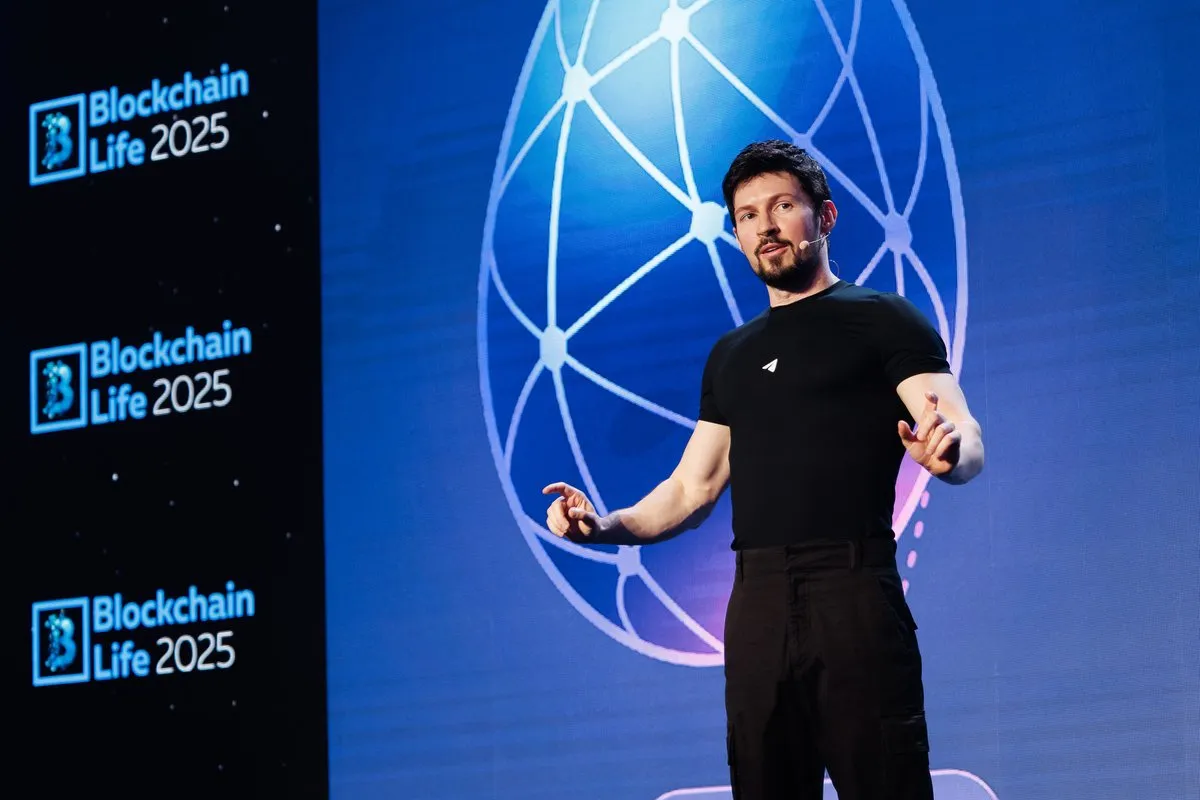 Pavel Durov during his appearance at Blockchain Life 2025 in Dubai [ua.news]
Telegram was first launched in 2013, and during its first three months the application was downloaded one million times without any advertising spending. A clear jump in Telegram’s popularity came in 2014 after a major four-hour outage of its competitor WhatsApp. More than 5 million new accounts were registered on Telegram at that time.
Over the following years, the number of users also increased because of restrictions imposed on alternative messengers in several countries around the world. Telegram quickly gained new users by building its brand around independence and security. Naturally, as its popularity increased and it promoted itself as one of the most secure messengers, Telegram also came into conflict with state regulators for various reasons.
Privacy as Part of the Brand
According to Durov, the market lacked an application that would prioritise security, speed and confidentiality of communication between users. Telegram is certainly an unusual and convenient communication application, but privacy is marketed as part of its competitive advantage. This privacy is supposed to be supported by its distributed data-centre infrastructure, proprietary cryptographic protocol and Durov’s independence from state institutions. However, it is important to distinguish the operator’s claims from technical guarantees.
Telegram officially distinguishes between two types of messaging as a deliberate design decision: Secret Chats and Cloud Chats. Cloud Chats, as the name suggests, store messages in the cloud to make synchronisation between devices and message search easier, which means they are not end-to-end encrypted (E2E). Secret Chats are optional conversations between two users and are end-to-end encrypted (E2E). A Secret Chat must be activated manually in the application.
In 2024, Telegram clarified in its privacy policy the possibility of providing law enforcement authorities with users’ phone numbers and IP addresses in cases involving suspected criminal activity and a valid legal request.
The application also collects information about user activity that provides information about their behaviour (metadata). Telegram updated its privacy policy on 21 August 2026. It describes the possibility of matching advertisements based on public channels, their categories and an approximate country or city determined from an IP address or from the country and calling code of a phone number.
Why Telegram?
Telegram was designed to handle millions of users, billions of messages per day and very large groups while maintaining speed and synchronisation across devices. According to figures provided by Durov in 2025, Telegram surpassed 1 billion monthly active users. The average user opens the application 21 times per day and spends around 41 minutes there daily. In 2024, Telegram reported 950 million active users.
It is worth looking at how the application grew because its success cannot be explained only by the privacy promoted by its founder.
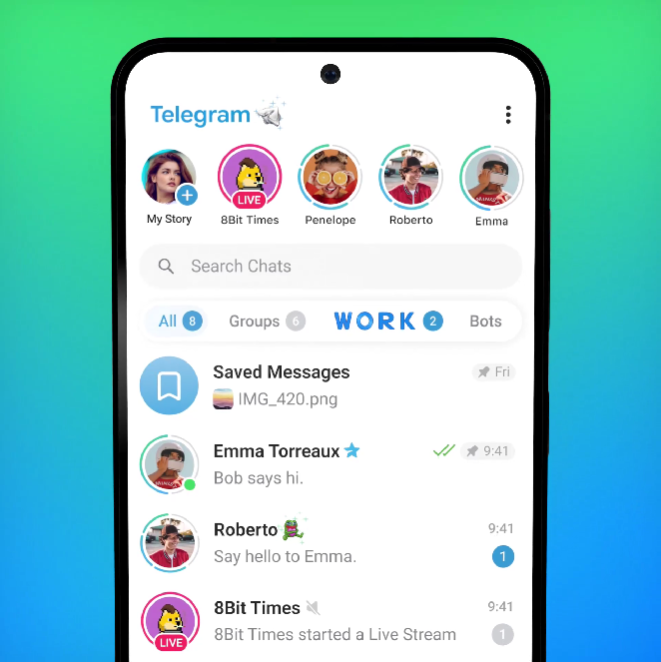 An illustration showing Telegram’s typical messenger-style interface on Android [telegram.org]
Functional Evolution
In 2013–2014, Telegram remained a somewhat unusual cloud-based messenger. In 2014, usernames and links were introduced, allowing users to contact someone without knowing their phone number.
In 2015, Telegram launched the Bot API, allowing external developers to create services operating inside Telegram.
In 2017, Telegram introduced payments for bots, allowing users to order, for example, a product or service without leaving the application. In 2021, it expanded this model so that merchants could accept card payments directly in chats through external payment providers.
In 2022, the application introduced Web Apps (Mini Apps). This allowed developers to build full web interfaces inside Telegram using JavaScript, such as catalogues, stores, games or tools.
In 2024, Telegram launched Telegram Business, making it possible to provide opening hours and location, use automated replies and integrate chatbots. Telegram also began sharing 50% of its advertising revenue with channel owners (the programme initially covered public channels with at least 1,000 subscribers) when advertisements appeared below their channel content. At the same time, it developed its internal Stars currency and monetisation for bots and Mini Apps.
In this way, Telegram began competing not only with WhatsApp, Viber or Signal, but also with social media platforms, blogs, marketplaces and simple business applications. Channels made it possible to build an audience, bots to provide services, payments to process transactions, and Mini Apps to launch complete digital products without leaving the platform.
Its Own Financial Layer
In 2017, the Telegram team began working on the Telegram Open Network (TON), its own blockchain platform whose native cryptocurrency was intended to be Gram. In 2018, Telegram raised funding from investors. This was done through a private sale of rights to future Grams. The blockchain itself had not yet been publicly launched, and Grams were not yet functioning as a normally available cryptocurrency.
In 2019, however, the project entered into conflict with the U.S. Securities and Exchange Commission (SEC). The SEC argued that the sale of rights to future Grams constituted an unregistered securities offering.
In 2020, Telegram reached a settlement under which it agreed to return investments and pay a financial penalty. It then withdrew from its own TON and Gram project, while development continued through an independent community under the name The Open Network, with Toncoin as its token.
Since 2025, Telegram has required blockchain functionality in Mini Apps to use TON and TON Connect. In 2026, the integration with Telegram deepened further. Toncoin was renamed Gram, while the blockchain itself retained the name The Open Network.
Telegram in the Post-Soviet Space
Telegram initially had an English-language interface, while a Russian version appeared only in 2017. The application achieved particularly strong popularity in Russia, Belarus, Ukraine and Uzbekistan. In some countries, such as Kazakhstan and Kyrgyzstan, Telegram remains an important application but is not the dominant messenger. In Georgia, its position remains clearly weaker than WhatsApp or Viber, and it is viewed as a relatively niche application.
In some countries, Telegram is treated as a major source of information, partly taking over the role of traditional media. With the development of channels, the application quickly became an important tool for distributing news and political content.
Most popular messengers in selected post-Soviet countries
Country | 1st | 2nd | 3rd |
|---|---|---|---|
Belarus (2024) | Viber (70%) | Telegram (33%) | WhatsApp (28%) |
Russia (2026) | MAX (70%) | Telegram (61%) | WhatsApp (52%) |
Ukraine (2026) | Telegram (74%) | Viber (59%) | FB Messenger (54%) |
Kazakhstan (2023) | WhatsApp (83%) | Telegram (39%) | - |
Uzbekistan (2023) | Telegram (70%) | WhatsApp (18%) | IMO (4%) |
Source: author's own compilation based on available national studies. The data are not directly comparable between countries because they come from different years, samples and research methodologies. [thinkthanks.pro, viedomosti.ru, gradus.app, researchgate.net, ca-barometer.org]
Belarus
On the Belarusian market, Telegram’s main competitor remains Viber, which has Belarusian-Israeli roots. Telegram gained significant popularity during the 2020 protests. During internet restrictions, it remained partially accessible and worked relatively effectively through proxies and VPNs, becoming one of the main channels for distributing information and communication. The authorities did not, however, introduce a nationwide block of the application. Telegram remains an important communication platform in the country.
Russia
The history of relations between Telegram and the Russian authorities is particularly complicated and, at times, absurd. Telegram refused to provide encryption keys at the request of the Federal Security Service (FSB). Between 2018 and 2020, the Russian regulator Roskomnadzor began enforcing a decision to block the application. During unsuccessful attempts to restrict Telegram, government applications and competing services were sometimes blocked by accident, while Telegram itself, despite initial problems, remained accessible to most users. At the same time, official channels of Russian state institutions, including the Ministry of Foreign Affairs, remained active on Telegram.
The situation continued until 2020, when the Russian authorities lifted the block, citing Durov’s declared willingness to cooperate in combating terrorism and extremism. Telegram denied, however, that it had reached any agreement on the matter.
From 2022, following Russia’s full-scale invasion of Ukraine, the state began restricting access to some competing applications, and Telegram’s popularity increased rapidly. As a result of the restrictions, advertising budgets, creators and marketing activity moved to Telegram.
From 2025, the Russian authorities again began restricting access to Telegram. In March 2026, the restrictions were tightened significantly further. The scale of blocking currently differs between networks, while some users bypass the restrictions using VPNs.
At the same time, the state strongly supports and promotes the MAX messenger. Because alternative applications for communicating with people in Russia have become more limited, MAX is also gaining popularity outside the country. One reason is the possibility of maintaining contact with people living in Russia, for example family members.
Ukraine
The first major increase in Ukrainian users came in 2017 after the state blocked the Russian social networks Odnoklassniki and VKontakte. Before the full-scale war, Telegram was not the market leader, although it already had a large young user base. The war radically accelerated adoption of the application. Users could follow information about shelling, air-raid alerts, troop movements and developments in particular regions more quickly and easily than through traditional media.
Ukraine’s central and regional authorities used Telegram to communicate with society more quickly by creating official channels. The approach to the application changed in 2024, when a decision was made to prohibit the installation of Telegram on official devices in institutions critical to the state. The reasons included cybersecurity, geolocation risks, concerns about espionage and data leaks. Despite this, the state still uses the application to communicate with society, although it does not treat it as a secure tool.
Uzbekistan
Telegram gained a strong position in Uzbekistan’s digital infrastructure in the middle of the previous decade. This resulted, among other factors, from restrictions imposed at the time on other messengers and the relatively poor quality of mobile internet. Its relatively low data requirements gave it an advantage over other applications. Later, this advantage became stronger as media organisations, businesses and state institutions joined the platform. Telegram is used to follow information, search for jobs and trade goods and services.
What is particularly characteristic is that state institutions use bots not only to publish information, but also to handle specific public services:
MyGov has its own Telegram bot,
@myGovUzSupportBot, through which users can report problems and ask questions related to e-government services.The Ministry of Justice uses
@antikorbotfor reporting corruption.The tax administration also operates
@Efactura_Bot. It allows users to check the status of electronic invoices, contracts, powers of attorney, transport documents and other records, while uploading a document with a QR code makes it possible to verify its status and download the original PDF.
In 2023, George Lobushkin, a Telegram spokesperson, stated that Uzbekistan ranked second after Russia in terms of the number of channels and their audience. At the time, there were 123,000 channels and 18,000 groups.
Kazakhstan
Telegram holds an important position in Kazakhstan but is not the dominant application. WhatsApp established itself earlier as the leading tool for private communication. Telegram remains popular as a platform for channels and information.
Common Characteristics of Users
It is not possible to create a single profile of a typical Telegram user across the post-Soviet space. However, several common characteristics can be identified. The most detailed profiling of Telegram users was conducted by TGStat in 2023 among Russian-speaking users. If we compare age-related studies from Belarus, Ukraine, Russia and Uzbekistan, we can see that Telegram initially had a younger user base. In more recent studies, the largest group of users is now aged 25–44. This is a particularly important group from the perspective of the labour market, consumption and business activity.
Selected characteristics and ways of using Telegram
Users aged 25–44 | Users with higher education | Use Telegram to communicate with co-workers | Use Telegram to communicate with clients | Get information about the world from Telegram | Use bots on Telegram |
|---|---|---|---|---|---|
53% | 62% | 52% | 26% | 80% | 40% |
Source: author's own compilation based on TGStat 2023 research concerning the Russian-speaking segment of Telegram users. [tgstat.ru]
From Messenger to Business Infrastructure
Business communication in some post-Soviet countries may look different from communication in many European companies. Messengers may play a greater role in building relationships with business partners than email. From my own observations, later arrangements made through a messenger can influence how formally agreed contractual terms are implemented in practice. This results, among other things, from the greater role of personal relationships and informal rules, which allow for a more flexible approach.
A Channel as Your Own Media
The basic tool for one-to-many publishing on Telegram is, of course, the channel. It works somewhat like a blog or newsletter, where a company publishes information, promotions, updates, educational content and entertainment. Telegram does not have the classic algorithmic feed found on social media platforms. A new publication simply moves the channel higher on the subscriber’s chat list and notifies them of a new message if notifications are enabled.
Telegram provides extensive analytics for administrators of sufficiently large channels, including subscriber growth, shares, reactions, sources of views and hours of highest activity. This is the most reliable source of information about your own channel.
A hair salon, for example, can treat a channel as more than just advertising. The channel can help build expertise and reputation through direct communication and ongoing relationships with its audience. It can also be used to publish available appointment slots and manage unused service capacity more easily. Effectiveness can then be measured through reach, engagement, booking clicks, subscriber-to-lead conversion and the share of repeat visits. This supports a process that moves from content and trust to contact, booking and repeat visits.
Advertising and the Attention Market
Posts published on channels are seen primarily by their subscribers. There are no classic social-media algorithms deciding whether to show content to a random Telegram user. Small channels do not attract attention automatically. Without marketing activity and advertising, few users will discover the channel. A business therefore needs to think about creating original content that people consider worth sharing.
Other platforms can be used to attract attention to a channel, but Telegram also has its own distinct methods of acquiring subscribers. Within the application, a company can contact the administrator of another channel, negotiate a price and purchase advertising, or agree to exchange posts as part of a barter arrangement.
The administrator of a large channel operates somewhat like a media publisher monetising access to a community. Channels can be selected by geography, topic, reach or engagement, and advertising prices differ between them. There is also an entire market of intermediaries and advertising exchanges, such as Telega.in, where advertisers can pay to access a specific community.
For a local offline business, advertising is usually sought in local groups, city channels or regional channels. Channels built around cities such as “Tashkent” or “Almaty” make it possible to reach an existing local Telegram community.
Depending on what needs to be analysed, many different tools are available for analysing your own channel, competitors, the advertising market, content, groups or brand mentions. There is no single tool for everything. An external infrastructure has developed around Telegram that helps professionalise the market.
TGStat is a very extensive tool for analysing the broader Telegram ecosystem.
Telemetr is useful for analysing channels and advertising.
Popsters helps identify the most effective content.
Telegram’s official advertisements are considerably more modest than ads on familiar social media platforms. In public channels, an advertisement appears below regular channel posts when the user scrolls through the content. It may include a title, short text, optional media and a button leading to the promoted destination. Ads can be matched to the topic of the channel or to a search query.
A Marketplace Without a Marketplace
In Uzbekistan, Telegram has become one of the layers organising local trade and the distribution of classifieds. Telegram works like a more decentralised classifieds board: a seller posts a photo, description, price and contact details, while an interested buyer moves directly into a conversation. An administrator who builds a channel or group around a particular city or category provides access to that community, either free of charge or for a fee.
The chat itself does not provide advanced filters, a reputation system, buyer protection or transaction handling. The TG Market catalogue lists more than one hundred Uzbek channels operating in a marketplace-like model. Offers include cars, apartments, jobs and other services.
Contact, Sales and Customer Service
Telegram Business introduced a set of features that make it possible to turn a standard account into a business account and use it for customer service. A company can provide opening hours and an address, as well as create a custom start page before a conversation begins. Other features include quick replies to recurring questions, automated messages, tagging and conversation management.
Businesses can effectively build simple sales funnels without leaving Telegram. A process may begin with an advertisement on another channel, then bring interested users to the company’s own channel and show them additional content that builds trust. During contact and ordering, a bot or external integration can be used, and data from such interactions can then be transferred to a CRM.
A sample flow for a beauty salon might work as follows. A post about a treatment encourages the user to book through chat. The user receives an automated welcome message and a quick reply containing the price list. The client makes a booking and later receives confirmation and a reminder about the upcoming appointment.
A Bot as an Employee
A Telegram bot is a communication tool that automatically sends messages and interacts with customers. If a channel solves the problem of one-to-many communication, a bot helps scale one-to-one interaction.
A bot can replace part of customer service, for example when providing information about order status, discounts, FAQs or registration. More advanced bots integrated with external systems can perform calculations, collect information needed for an order or guide the user through subsequent stages of a process. If a case requires human involvement, the conversation can be transferred to a consultant.
Business Inside the Application
With the arrival of Mini Apps, Telegram stopped being only a place for contacting a company and became an environment in which a user can actually use a service or complete a transaction. There is no need to move to an external website or download another application. A Mini App is a web application created by an external developer, but it runs directly inside Telegram and can offer forms, catalogues, shopping carts, bookings and other interactive functions.
A typical process might begin when a user sees an offer on a channel and moves to a Mini App, where they select a product or service, enter the required information and proceed to a payment handled by an integrated provider.
For some companies, this can lower the entry barrier compared with building and distributing a separate mobile application. There is also no need to convince users to install another programme, while the path between viewing an offer and taking action becomes shorter. The company nevertheless remains dependent on Telegram’s infrastructure, while more advanced solutions still require their own backend and integrations.
An interesting example is Takleef, an Uzbek B2B promotional platform targeting the FMCG sector. The system operates through Telegram Mini Apps and a promotional bot. A brand can run a campaign in which a customer submits a receipt and the system uses OCR to verify it automatically. Once the purchase has been correctly recognised, the user can receive cashback or participate in promotional mechanisms such as games or quizzes. On the brand side, the system also provides anti-fraud tools and analytics for evaluating campaign effectiveness.
When Does Telegram Matter for Business?
Telegram is particularly interesting when the target group already actively uses it. The company does not need to convince customers to install another tool and can use the existing infrastructure of channels, bots and Mini Apps.
However, high Telegram penetration in a country does not automatically mean that it will be a good channel for every business. A company should check:
whether its target customers actually use Telegram,
which channels and communities bring this group together,
how much it costs to reach them,
whether sales can be handled through chat, a bot or a Mini App,
whether dependence on the platform is acceptable.
The Dark Side of the Ecosystem
The same characteristics that lower the entry barrier for legitimate business can also make illegal activity easier to organise. A channel can easily be created by an entrepreneur, but also by a scammer. A bot can automate customer service, but similar mechanisms can be used to automate fraud. Informal marketplaces do not provide buyer protection, seller reputation systems or offer verification by default.
As a result, the ecosystem includes fake job channels, impersonation of companies, investment scams and the promotion of illegal or unauthorised gambling services. Telegram is also used to sell illegal substances and to process payments through cryptocurrency-based schemes.
This does not mean complete anonymity. A Telegram account is linked to a phone number, but the user can hide that number from others and operate publicly under a username. Combined with the ease of creating new channels, groups and bots, this makes it harder for an ordinary user to determine who is actually on the other side of a transaction.
Before completing a transaction, the key issue therefore remains trust: has the administrator verified the offer, does the company really exist, are the channel statistics genuine, and is there any way to recover money in the event of fraud?
Telegram is also developing mechanisms to counter such abuse. Moderation of public content combines automated tools, human moderators and user reports.
Telegram’s greatest advantage and one of its greatest risks therefore partly share the same source: the low barrier to creating communities, services and markets around an existing network of users.
Conclusion
Telegram’s success does not come from one particular feature, but from a broader platform that has absorbed functions associated with social media, blogs, marketplaces and classifieds boards. Its popularity has been shaped by a combination of local events, crises, restrictions and limitations imposed on competing platforms. Telegram did not succeed on privacy alone. A messenger evolved into a platform combining private communication, public content distribution and service tools. Telegram did not replace one competitor; it began replacing parts of many different applications.
Telegram has not dominated the entire post-Soviet space. WhatsApp and Viber maintain strong positions in some countries, while Telegram remains relatively niche in others. Telegram’s development followed a different path in each country, and these local factors shaped its popularity. The more users joined the platform, the more media organisations, institutions and companies followed with their own channels and groups, creating a self-reinforcing effect.
Telegram lowered the barrier to organising certain business processes, while in some markets its importance was further strengthened by restrictions on competing platforms and by less developed specialised digital services. Companies do not necessarily need to build a separate application, require customers to register or create separate publishing tools. The application also provides a relatively simple interface for users. Telegram’s protocol was designed, among other things, to work efficiently on weaker mobile connections, making communication and access to information easier in such conditions. At the same time, it is important to remember that this low barrier to entry works in both directions and can also facilitate fraud and illegal activity.
The Telegram phenomenon does not come from being the best messenger for private conversations, but from becoming an ecosystem that combines many different tools within a single application — while maintaining a simple and intuitive interface.
[101-app.com] Telegram dlya biznesa: chto eto takoe, vozmozhnosti, boty, Telegram Premium.
[b2b.insight.uz] Issledovanie po polzovatelskomu povedeniyu v Telegram.
[belta.by] Kakie messendzhery i sotsseti naibolee populyarny v Belarusi? Rasskazal sotsiolog.
[bitrix24.ru] Kak prodavat v Telegram: effektivnye strategii i sovety dlya razvitiya onlayn-biznesa v messendzhere.
[bulletin-journalism.kaznu.kz] Digital Transformation: A Comparative Analysis of Information and Communication Technologies and Media in Kazakhstan and Uzbekistan.
[ca-barometer.org] Kakie messendzhery populyarny v Uzbekistane, Kyrgyzstane i Kazakhstane?
[edna.kz] Trendy messendzherov v Kazakhstane 2025: budushchee i perspektivy WABA.
[elama.ru] Kak vesti Telegram-kanal s nulya: sozdanie, vedenie, prodvizhenie i kontent-plan dlya biznesa i blogov.
[forbes.ru] I vtorye stanut pervymi: Telegram oboshel WhatsApp po populyarnosti v Rossii.
[freedomhouse.org] Ukraine: Freedom on the Net.
[gazeta.uz] Ot SMS k Telegram: Infobip delitsya klyuchevymi trendami v kommunikatsii s klientami.
[gerabot.com] Populyarnost messendzherov v Ukraine v 2022–2025 godakh: Telegram, Viber i WhatsApp.
[gov.uz] Follow the official Telegram pages of government agencies!
[gradus.app] Changes in media consumption: how Ukrainians divide their attention across platforms and screens in 2026.
[habr.com] Vse chto nuzhno znat o biznese v Telegram, prezhde chem khotya by chikhnut v etu storonu.
[ideadigital.agency] Telegram dlya biznesa.
[internews.ua] Over One-Third of Ukrainians Turn to News Exclusively from Social Media.
[kontur.ru] Kak prodvigat biznes v Telegram.
[kz.kursiv.media] Kazakhstan stal odnim iz liderov po skachivaniyu messendzhera Max za predelami Rossii.
[predprinimatel.ru] Prodvizhenie kanala v Telegrame: kak prodvigat v 2026 godu.
[pravda.com.ua] Ukrainian Parliament to restrict Telegram usage.
[radist.online] Zachem biznesu Telegram i kak sozdat korporativny kanal.
[retail.ru] Kak prodvigat malyy biznes v Telegram: metody i instrumenty.
[richads.com] Kazino v Telegram: kak reklamirovat v 2026.
[sec.gov] Telegram to Return $1.2 Billion to Investors and Pay $18.5 Million Penalty to Settle SEC Charges.
[t.me] Pavel Durov’s official Telegram channel.
[t-j.ru] Biznes-akkaunt v Telegrame v 2026 godu: kak sozdat, chto daet i kak polzovatsya.
[telega.in] Telegram advertising exchange.
[telegram.org] The Evolution of Telegram.
[uz.kursiv.media] Uzbekistantsy v avguste podseli na IMO.
[uzneo.uz] Restaurant Mini App — menu and booking in Telegram.
[vc.ru] Kak delat biznes v Telegram? Opyt osnovatelya Telegram-seti na 2.5 mln podpischikov.
[vedomosti.ru] Max stal krupneyshim messendzherom po mesyachnomu okhvatu v Rossii.
[bulletin-journalism.kaznu.kz] D.S. Azimzhanov, K.N. Myssayeva — Digital Transformation: A Comparative Analysis of Information and Communication Technologies and Media in Kazakhstan and Uzbekistan.
[Journal of Social Policy Studies] Elena Bogdanova — Cross-Cultural Collaboration in Contemporary Russia: Problems of Contracting.
[Practical Marketing] Ilya V. Rozhkov, Anastasia I. Strashevskaya, Darya S. Belyaeva, Sofia V. Kalimullina — Development of a Strategy for Promoting a Children’s Club in the Telegram Messenger.
[Vestnik Nizhny Novgorod University. Social Sciences] D.A. Kornilov, D.A. Zaitsev — Estimation of Advertising Turnover in Russian-Language Telegram Channels.
[Vestnik Nauki] M.O. Belyakina — Telegram Channel as a Way to Implement a Cosmetology Center’s Content Strategy.
[Innovative Economy: Prospects for Development and Improvement] L.A. Ponkratova, E.V. Molodchikova, A.I. Littebrant — SMM Services Market in Russia: Transformation and Main Trends.
[Vestnik Akademii Znaniy] E.V. Denisova, G.V. Petrova — Overview of Business Presence in Social Networks.
Author
Damian Niedźwiecki


